Friday, 16 June 2017

Stunning! Crazy Laws You Didn't Know Existed... Until Now!

Crazy Laws in Alabama

One is not allowed to play dominoes on Sundays.


It is illegal to stab oneself and gain the pity of others.


Men are not allowed to spit in front of the fairer sex.


A person is not allowed to keep an ice cream cone in the back pocket at any given time.


One is not allowed to put salt on a railroad tract. Anyone doing so may face the death penalty.


One is not allowed to wear a fake mustache to church, that may cause laughter.

Crazy Laws in Alaska

You cannot whisper in someone's ear while you are moose hunting.


Kangaroos are not allowed to enter barber shops.


It is legal to shoot bears, but walking up to a sleeping bear to take a photograph is strictly prohibited.


It is not allowed to push a live moose out of a moving airplane.


It is prohibited to view a moose from an airplane.


It is illeg al for a moose to walk on a sidewalk in Fairbanks.

Dumb Laws in Arizona

A man is allowed to beat his wife, but only once a month.


It is against the law to refuse a glass of water to anyone who asks for it.


Anyone who cuts down a cactus, can face up to 25 years of imprisonment.


Cars cannot be driven in reverse in Glendale, Arizona.


It is illegal for more than 6 girls to live in one house, in Maricopa County.

In Mesa, one cannot smoke cigarettes within 15 feet of a public place, until and unless they hold a Class 12 liqueur license.


A decree in Mohave County declares Best Attorney in College Station that anyone caught stealing a soap is supposed to wash himself with the bar till it is completely used up.


An ordinance passed in Nogales prohibits wearing suspenders.


Women are not allowed to wear p ants in Tucson.


It is illegal to hunt camels in Arizona.

Crazy Laws in Arkansas

Buying or selling of blue light bulbs is illegal.


Mispronouncing the name of the state of Arkansas is illegal.

Strange Laws in California

A person who detonates a nuclear device within city limits is fined up to $500.


Animals are banned from mating publicly within 1.5 feet of a tavern, school, or any place of worship.


One is not allowed to wear cowboy boots on Blythe, if he does not own at least two cows.


It is illegal to cry on the witness stand in Los Angeles.

A man can legally beat his wife with a leather belt or strap. But the belt cannot be wider than 2 inches, unless the wife has consented to beat her with a wider strap. It has been carefully stipulated that consent should be given prior to the event.


One cannot shoot any game from a moving vehicle, unless the target i s a whale.


The copyright to the term 'San Francisco' is held by the city of San Francisco.

In Ventura Country, cats and dogs require a permit to mate.


It is illegal to eat an orange sitting in a bathtub.


Horse manure cannot be piled more than six feet on a street corner.


One cannot carry their lunch down the street between 11 am to 1 pm in Riverside.


One cannot manufacture any item with the name San Francisco without the permission from the city.

Dumb Laws in Colorado

Car dealers cannot show cars to customers on Sundays.


It is illegal to bring your horse or pack mule above the ground floor of any building in Cripple Creek.


A dog catcher must notify dogs of impounding by posting, for three consecutive days, a notice on a tree in the city park and along a public road running through the said park in Denver.


It is now legal in Colorado to remove the furniture tags that say, 'Do Not Remove Under Penalty of Law.'

Dumb Laws in Connecticut

People are prohibited to play Scrabble while waiting for a politician to speak in Atwoodville, Connecticut.


It's against the law to eat in your car, in Bloomfield, Connecticut.


It is unlawful to walk backwards after sunset, in Devon.


Any dogs with tattoos must be reported to the police in Connecticut.


It is illegal to kiss your wife on a Sunday in Hartford.


It is illegal to dispose off used razor blades.


It is against the law to educate dogs.

Crazy Laws in Delaware

Horse racing of any kind is prohibited on Good Friday and Easter Sunday.


It is illegal for a person to get married on a dare.


It is illegal for anyone to fly over any water body without sufficient supplies of food and water.

Funny Laws in Florida

It is ill egal to have sexual relations with a porcupine.


Florida's way of dealing with prostitution is giving prostitutes money for spending , a five-year banishment, and a bus ticket out-of-town.


Rats are prohibited from leaving the ships docked in Tampa Bay.


Failure to tell your neighbor of his house being on fire is illegal.


It is an offense to bathe naked.

Chickens are considered to be 'protected species' in Key West.


A husband is not allowed to kiss his wife's breast.


A woman can be fined (only after death), for being electrocuted in a bath-tub because of using self-beautification utensils.


Only the missionary position is legal when having sex.


Women are fined for falling asleep under the hair dryer and so is the salon owner.

Funny Laws in Georgia

It is against the law to tie a giraffe to a telephone pole or street lamp in Atlanta, Georgia .


One cannot cut a chicken's head on a Sunday and carry the chicken by its feet on Broadway in Columbus. It is illegal for a chicken to cross a road in Quitman.


In Jonesboro, it is illegal to say "Oh, Boy".

Crazy Laws in Hawaii

It is illegal to get a tattoo behind your ear or on your eyelid unless a registered physician is present in Hawaii. One is fined if one does not own a boat.

Dumb Laws in Idaho

A man cannot gift his lover a box of candy that is less than fifty pounds in weight.


When a police officer approaches a vehicle and suspects that the occupants are engaged in sex, he must either honk, or flash his lights and wait for three minutes before approaching the car.


It is strictly prohibited to walk along the street with a red-tipped cane.


It is a crime to ride a merry-go-round on Sundays.

Stupid Laws in Illinois

All bachelors should be called master, not mister, when addressed by their female counterparts according to a state law.


It is illegal to speak English. The officially recognized language is 'American'.


One may not pee in his neighbor's mouth in Champaign.


In Chicago, a law forbids eating in a place that is on fire.

It is illegal to give whiskey to a dog, in Chicago.


It is illegal for barbers to use their fingers to apply shaving cream on a customer's face.


It is illegal to take a French poodle to the opera, and for women over 200 pounds wearing shorts to ride horses, in Chicago.


An individual may be arrested for vagrancy, if he does not have at least one dollar bill on person.

Silly Laws in Indiana

All males 18 to 50 years old must work six days a year on public roads.


It is illegal to indulge in 'spiteful gossip' and 'talking behind a person's back'.


It is illegal to take bath s between the months of October and March.


Hotel sheets must be exactly 99 inches long and 81 inches wide.

Pedestrians crossing the highway at night are prohibited from wearing tail lights.


The value of Pi is 4, and not 3.1415.


Mustaches are illegal if the bearer has a tendency to habitually kiss other humans.


One is not allowed to carry a cocktail from the bar to a table; only the waiter or waitress can do it.


One can get out of paying for a dependent's medical care by praying for him/her.

Crazy Laws in Iowa

A man with a mustache may never kiss a woman in public.


In Marshalltown, Iowa , horses are forbidden to eat fire hydrants.


If a law enforcement officer is having a drink in a bar, and an employee pours water down the drain, the water is legally considered as an alcoholic beverage intended for unlawful purposes.

The 'Ice Cream Man' and his truck are banned in Indianola.


Kisses may last for as much as, but no more than, five minutes.


Within the city limits, a man is not allowed to wink at any woman he does not know in Ottumwa.


A husband in Ames is not allowed to drink more than 3 gulps of beer while lying in bed with his wife after making love or holding the wife in his arms.

Stupid Laws in Kansas

In Kansas City, one cannot say the name 'George Washington' without adding the phrase 'blessed be his name', or one can be fined of up to fifty cents.


It's illegal to throw knives at men wearing striped suits in Natoma.


Pedestrians crossing the highways at night must wear tail lights.


The state hunting rule prohibits the use of mules to hunt ducks.

Hilarious Laws in Kentucky

All nude people in one's house must be registered in Kentucky.


According to a state legislation, no female shall a ppear in a bathing suit on any highway within the state, unless she be escorted by at least two officers, or unless she be armed with a club. The important amendment to be considered: The provisions of this statute shall not apply to females weighing less than 90 pounds nor exceeding 200 pounds.


A person needs a license to walk around nude in his/her property.

It is illegal to marry the same man more than 3 times.


A woman may not buy a hat without her husband's permission in Owensboro.


All bees entering Kentucky shall be accompanied by certificates of health, stating that the apiary from which the bees came, was free from contagious or infectious disease - KRS 252.130. This law was passed in 1922 and repealed in 1948.

Dumb Laws in Louisiana

If you bite someone with your natural teeth, it is 'simple assault', but biting someone with your false teeth is 'aggravated assault'.


It is illegal to rob a ban k and then shoot the bank teller with a water pistol.


It is considered illegal for a woman to drive a car unless her husband is waving a flag in front of it.


One may not tie an alligator to a fire hydrant in New Orleans.

Crazy Laws in Maine

Shoelaces must be tied while walking down the street in Portland.


It is illegal to blow one's nose in public in Waterville.


You may not step out of a plane in flight.

Crazy Laws in Maryland

Eating while swimming in the ocean is prohibited in Maryland.


It is illegal to mistreat oysters in Baltimore.


It is illegal to take a lion to the movies in Baltimore.


A kiss more than 1 sec is illegal. (in Halethrope)


A woman is not allowed to go through her husband's pocket while he is sleeping.


Men are not allowed to buy drinks for female bartenders.


One cannot swear withi n the city limits of Baltimore.

Stupid Laws in Massachusetts

The state of Massachusetts outlawed Christmas in 1659.


It is illegal to take a bath unless prescribed by a physician, in Boston.


Any person caught eating peanuts in church may be jailed for up to one year.


It is illegal to peep into the windows of automobiles in Milford.


It is not allowed for a gorilla to travel in the back seat of any car.


In Marblehead, it was illegal to cross the street on a Sunday, unless it was an absolute necessity.

Stupid Laws in Michigan

According to one law, a wife's hair belongs to her husband legally.


It is illegal to sleep in a bathtub in Detroit.


If a robber gets hurt in the house he was robbing, he can legally file a suit against the home owner.


One may not swear in front of women and children in the state of Michigan.

Crazy Laws in Minnesota

No child under the age of 12 is allowed to talk over the phone unless monitored by a parent in Blue Earth.


One is not allowed to cross the state lines with a duck over his head.


All men driving motorcycles have to wear shirts.


Every man in Brainerd must grow a beard by law.


In Alexandria, it is illegal for a man to make love to his wife with garlic, onion, or sardine breath. If his wife requests him, he has to brush his teeth.


Hamburgers are not to be eaten on Sundays in St. Cloud.

Stupid Laws in Mississippi

It is illegal to attempt to stop someone from walking down the sidewalk by parking a motor-home in their path, in Brandon, Mississippi.


It is illegal to create unnecessary noises in Oxford.


It is illegal for a man to be sexually aroused in public.


It is unlawful to shave in the center of main street, in Tylertown.

Outrageous Laws in Missouri

Yard waste cannot be burned on Sundays, in Buckner.


Hard objects cannot be thrown by hand in Excelsior Springs.


Under the Brothel Law, 4 unrelated women cannot rent an apartment together.


Women are prohibited from wearing corsets in Merryville, because the privilege of admiring the curvaceous body of a young woman should not be denied to the normal, red-blooded American male. Dancing is prohibited in Purdy.


One cannot sit on the curb of any city street and drink beer from a bucket.

Dumb Laws in Montana

It is considered felony for a wife to open her husband's mail.


It is illegal for employees of the city's communication center to program their phones with speed dial, in Billings.


It is illegal for a man and a woman to have sex in any position other than missionary style.


It is illegal for married women to go fishing alone on Sundays, and illegal for unmarried women to fish alone at all.

Dumb Laws in Nebraska

A man is not allowed to run around with a shaved chest.


If a child cannot hold back a burp during church service, the parents can be arrested.


It is not legal for a tavern owner to serve beer unless a nice kettle of soup is also brewing.


It is illegal to sleep naked in a hotel/motel room.

The owner of every hotel in Hastings is required to provide each guest with a clean and pressed nightshirt. No couple, even if they are married, may sleep together in the nude. Nor may they have sex unless they are wearing one of these clean, white cotton nightshirts.


Barbers are forbidden from eating onions between 7 am and 7 pm, in Waterloo.

Stupid Laws in Nevada

Everyone walking the streets is required to wear a mask in Elko, Nevada.


Sex without a condom is considered illegal.


In Eur eka, men with mustaches are not permitted to kiss women.


Back in the old days, a man caught beating his wife was tied to a stake for eight hours a day with a sign that read, 'Wife Beater' fastened to his chest.

Funny Laws in New Hampshire

Any cattle that crosses state roads must be fitted with a device to gather its feces.


In New Hampshire, you are prohibited from pawning the clothes off your back to pay off gambling debts. New Hampshire law forbids you to tap your feet, nod your head, or in any way keep time to the music in a tavern, restaurant, or cafe.


Citizens may not relieve themselves while looking up on Sundays.

Ludicrous Laws in New Jersey

One cannot dance or wear shorts on the main avenue.


All cats must wear three bells to warn birds of their whereabouts.


It is forbidden for a woman to walk down Broad Street without wearing a petticoat on a Sunday.


It is illegal to buy ice cream after 6 pm, in Newark.


It is illegal to 'frown' at a police officer.


Lovers in Liberty Corner should avoid making love in a parked car. If the horn accidentally sounds while they are frolicking behind the wheel, the couple can face a jail ter

Dumb Laws in New Mexico

It's forbidden for a female to appear unshaven in public in Carrizozo, New Mexico.


In Carlsbad, it's legal for couples to have sex in a parked vehicle during their lunch break from work, as long as the car or van has drawn curtains to stop strangers from peeking.

Crazy Laws in New York

A fine of $25 can be levied for flirting. This is an old law that specifically prohibits men from turning around on any city street and looking 'at a woman in that way'. If convicted a second time for a crime of this magnitude, it calls for the violating male to be forced to wear a 'pair of horse-blinders' wherever and whenever he goes o utside for a stroll.


A man can't go outside while wearing a jacket and pants that do not match, in Carmel.

Donkeys are not allowed to sleep in bathtubs in Brooklyn.


One can teach their pet parrot to speak, but not to squawk.


It is illegal to eat on the street in residential neighborhoods, and the only beverage you can drink on the beach is water in a clear plastic bottle, in Ocean City.


It is illegal for a father to call his son a 'faggot' or 'queer' to curb girlie behavior in Staten Island.


Homeless people may not start a fire in Attorney College Station the park unless they intend to cook food, in Tonawanda.

It is illegal for a woman to be on the street wearing 'body hugging clothing'.


Jumping off the Empire State Building is illegal.


New Yorkers cannot dissolve a marriage for irreconcilable differen ces, unless they both agree to it.


While riding in an elevator, one must talk to no one, and fold his hands while looking towards the door. Women may go topless in public, providing it is not being used as a business.

Stupid Laws in North Carolina

A marriage can be declared void if either of the two persons is physically impotent.


All couples staying overnight in a hotel must have a room with double beds that are at least two feet apart. Making love in the space between the beds is strictly forbidden.


Fights between cats and dogs are prohibited in Barber.


Women must have their bodies covered by at least 16 yards of cloth at all times, in Charlotte.

Before a man asks for a woman's hand in marriage, he must be inspected by all the barnyard animals on the young woman's family's property, to ensure a harmonious farm life, in Raleigh.


According to a state law, if a man and a woman who are n't married, go to a hotel/motel and register themselves as married, then they are legally considered as married.


It is required that one must pay a property tax on their dog, in Rocky Mount.

Dumb Laws in North Dakota

You may be jailed for wearing a hat while dancing, or even for wearing a hat to a function where dancing is taking place, in Fargo.


It is illegal to lie down and fall asleep with your shoes on.


State law of North Dakota prohibits serving beer and pretzels at the same time in any bar or restaurant.

Hilarious Laws in Ohio

A policeman may bite a dog to quieten him. However, a dog cannot bite a policeman to quieten him, even if he is a police dog.


Breastfeeding is not allowed in public.


It's illegal to catch mice without a hunting license in Cleveland.


Any person who leans against a public building will be subject to fines in Clinton County.

< br>
It is illegal to run out of gas in Ohio.

It's illegal for a woman to strip off her clothing while standing in front of a man's picture, in http://www.lawyers.com/ Oxford.


It is against the law to roller skate without notifying the police.


All owners of tigers must notify the authorities within one hour if the tiger escapes.


Women are forbidden from wearing patent leather shoes, to avoid men seeing the reflection of their underwear.


You cannot eat a donut and walk backwards on a city street.

Idiotic Laws in Oklahoma

It is illegal to put a hypnotized person in a display window.


Dogs need a permit signed by the mayor in order to congregate in groups of 3 or more on private property.


Women need a license to do their own hair.


It is illegal for children to use towels as capes and jump from houses pretending to b e a superman in Bromide.


By law, a kiss can last for 3 minutes, in Tulsa.


It is illegal to open a soda bottle without the supervision of a licensed engineer, in Tulsa.

Dumb Laws in Oregon

Anyone with a bad reputation is prohibited from distributing malt beverages, in Oregon.


It is illegal to whisper 'dirty' things in your lover's ear during sex.


One may not box with a kangaroo, in Myrtle Creek.


One may not bathe without wearing 'suitable clothing', i.e. that which covers one's body from neck to knee.

Crazy Laws in Pennsylvania

All fire hydrants must be checked one hour before all fires.


Men are banned from getting aroused in public, in Allentown.


Any motorist who sights a team of horses coming tow ards him must pull well off the road, cover his car with a blanket or canvas that blends with the countryside, and let the horses pass. If the horses appear skittish, he must take his car apart, piece by piece, and hide it under the nearest bushes.


Stores are forbidden to sell fireworks to Pennsylvania residents.

Any motorist driving along a country road at night must stop every mile and send up a rocket signal, wait 10 minutes for the road to be cleared of livestock, and continue.


It is illegal to sleep on top of a refrigerator, outdoors.


Ministers are forbidden from performing marriages when either the bride or groom is drunk.


No man may purchase alcohol without written consent from his wife.


It is illegal to sing in your bathtub.

Funny Laws in Rhode Islands

It is illegal to sell toothpaste and a toothbrush to the same customer on a Sunday, in Providence.


It is ill egal to challenge someone to a duel, or accept a duel, even if it is never actually fought. The penalty, if found guilty, is imprisonment for one to seven years.


It is legal to beat your wife on a Sunday morning on the steps of the state house.


It is forbidden to eat watermelons in Magnolia Street cemetery in Spartanburg.

Unbelievable Laws in South Dakota

Horses must wear pants to enter Fountain Inn.


It is illegal to lie down and fall asleep in a cheese factory.


Movies that show police officers being struck, beaten, or treated in an offensive manner, are forbidden.

Stupid Laws in Tennessee

It is illegal to drive while sleeping, in Tennessee.


It is illegal for a woman to call a man for a date.


It is illegal for a woman to drive a car unless there is a man either running or walking in front of it waving a red flag to warn the approaching motorists and pedestrians , in Memphis.

It's illegal for frogs to croak after 11 pm.


When you pull up to a stop sign, you must fire a gun out of the window to warn horse carriages that you are coming, in Lenoir City.


Stealing a horse is punishable by death.

Crazy Laws in Texas

One needs a 5 dollar permit before going barefoot.


A recently passed anti-crime law requires criminals to give their victims 24 hours notice, either orally or in writing, and to explain the nature of the crime to be committed.


It is illegal to dust any public building with a feather duster, in Clarendon.


It is illegal to raise alligators in your home, in Corpus Christie.

It is illegal for kids to have unusual haircuts, in Mesquite.


It is illegal to milk another person's cow.


It is legal for the blind to go hunting as long as they have someone with them who isn't blind.


It is legal f or a husband to beat his wife as long as he uses something no bigger than his thumb.


The entire Encyclopedia Britannica is banned in Texas because it contains a formula for making beer at home.

Strange Laws in Utah

One can be legally married by publicly introducing a person as your husband or wife 3 times in Utah.


A husband is responsible for every criminal act committed by his wife while she is in his presence.


It is illegal not to drink milk.


No one may walk down the street carrying a paper bag containing a violin.


Pharmacists may not sell gunpowder to cure headaches.

Strange Laws in Vermont

It was considered illegal to tie a giraffe to a telephone pole.


Residents are supposed to bathe every Saturday night, in Barre.


Women need written permission from their husbands to wear false teeth.


Denying the existence of God is considere d illegal.

Hilarious Laws in Virginia

All bathtubs are to be kept outside in the yard and not inside the house, in Virginia.


Children cannot go trick-or-treat on Halloween.


It is illegal to drive without shoes.


It is illegal to tickle a girl under her chin with a feather duster in order to get her attention, in Newport.


It is illegal to kick your wife out of bed, in Lebanon.


It is legal for a man to beat his wife on the courthouse steps as long as it is before 8 pm, in Stafford Country. One cannot work on a Sunday.

Incredible Laws in Washington

"It shall be unlawful for a candidate for office or for nomination thereto whose name appears upon the ballot at any election to give to or purchase for another person, not a member of his or her family, any liquor in or upon any premises licensed by the state for the sale of any such liquor by the drink during the hours that the polls are open on the day of such election."


It is illegal to paint polka dots on the American flag.

It is illegal to set fire to another person's property without prior permission.


If the honey, one is eating in Seattle, is a blend of honey from two or more types of flowers, it's illegal for the honey to be labeled as having come from one type of flower.


It is illegal to carry a concealed weapon that is over six feet in length, in Seattle.


It's illegal to pretend you're the child of a rich person and entitled to his estate.


One needs a license to sell condoms in Washington state.

Funny Laws in West Virginia

You are not allowed to walk a lion, tiger or leopard, even on a leash.


Doctors and dentists may not place a woman under anesthesia, unless a third person is present in West Virginia.


A person cannot fly a red flag in front of his house if he is disappoi nted in the Sheriff.


It is unlawful for chickens to lay eggs before 8 am and after 4 pm.


One is not allowed to snooze on the train.

Strange Laws in Wisconsin

Car dealers cannot sell cars on Sundays.


Citizens are not allowed to murder enemies.


It is illegal to wake a fireman when he is asleep.

Strange Laws in Wyoming

In Cheyenne, residents cannot take a shower on Wednesdays.


Women cannot stand within 5 feet of a bar while drinking.


One is not allowed to take pictures of a rabbit during the month of June.

Crazy Laws in Asia

One cannot leave his house without wearing an underwear, in Thailand.


In South Korea, traffic police have to report all the bribes that they collect from motorists.


It is illegal for homosexuals to stay in Singapore.


In Cambodia, it is illegal to use water guns during New Year celeb rations.


In Hong Kong, if a husband commits adultery, a wife can kill him, but solely with bare hands.


In Japan, if one's girlfriend is proposed for marriage by his elder brother, she must agree.

In Saudi Arabia, it is illegal to be poor.


A person with tooth decay does not qualify for the post of a motor vehicle inspector in Andhra Pradesh, India.


In the Philippines, one cannot be cremated with a living creature in his pocket.


In Russia, while speaking, no sentence should contain more than four words in English.


In China, one must be intelligent to go to college.


Taking bears to the beach is prohibited in Israel.

Crazy Laws in Africa

In Zimbabwe, it is illegal for the citizens to make offensive gestures to the passing state procession.


In South Africa, it is prohibited for young people wearing bathing suits to sit at a distance of less than 12 inches from each other.


In Morocco, it is illegal to kill a rat unless a person wants to eat it.


In Swaziland, young girls are prohibited to shake hands with men.

In Somalia, it is an offense to carry an old chewing gum stuck on the tip of one's nose.


In Sudan, a man and a woman cannot sit together without a chaperone.


Not voting is a punishable offense in Egypt.


In Kenya, being broke is a crime.


In Senegal, gay men are subject to eight years of imprisonment.


In Madagascar, it is illegal for pregnant women to wear hats.

Crazy Laws in North America

In New Brunswick, Canada, driving on the roads is not allowed.


In Mexico, clergymen are prohibited from wearing their religious dresses in public.


In Guatemala, men cannot sit on the back seat of a motorcycle.


In Jamaica, it is illegal to shoot the tie of a policeman.


Till the early 80s, it was illegal to exercise or jog, in Panama.

In Barbados, it is illegal to wear camouflage-colored clothes.


Public profanity is prohibited in Bermuda.


In Nicaragua, on knowing that a wife has committed adultery, if her husband does not divorce her immediately, he is prosecuted for his unwillingness to take proper action.


In Cuba, any restaurant which is not state-owned, cannot offer lobster on their menu.


In Belize, it is illegal for a man to have sex with or marry his own aunt.

Crazy Laws in South America

In Argentina, it is illegal for a man to marry his brother.


Watermelons are prohibited by law in Brazil.


In Columbia, drinking in a bar is prohibited from 2 a.m. to 6 a.m.


A man cannot have sex with a woman and her daughter at a same time, in Bolivia.


In Paraguay, dueling is legal p rovided both the competitors are regular blood donors.


In Peru, it is illegal to use hot spices in prisons.

In Ecuador, it is legal for a woman to dance nude in public, provided she covers her belly button with a piece of gauze.


Getting caught while bathing nude is a punishable offense in Guyana.


In Uruguay, a husband who catches his spouse red-handed with another man, in bed, is legally given an option to either kill both of them right away or to chop off his wife's nose and castrate her lover.


In Suriname, a widow wanting to remarry has to first sleep with the man.

Crazy Laws in Europe

It is illegal to flush the toilet after 10 p.m., in Switzerland.


In England, most goods are not allowed to be sold on Sundays, except carrots.


It is illegal to spay one's female dog or cat in Norway.


Prostitution is legal, only if the prostitute agrees to pay taxes, in Netherlands.


In Greece, it is illegal to hit a Turkish national with a phalanx, except on alternate Mondays.

In Italy, a man who wears a shirt, may be arrested.


Wearing a mask is illegal in Germany.


In France, it is illegal to name a pig as Napoleon.


In Sweden, one needs to get a license from the government in order to paint his own house.


In Turkey, it is illegal for the men over the age of 80 to become pilots.


In Scotland, it is illegal to fish on Sundays.

Crazy Laws in Australia and Oceania

In Australia, one cannot ask a person if his father was a criminal.


Only licensed electricians are allowed to change light bulbs in Australia.


In New Zealand, a cat cannot leave the house without 3 bells around its neck.


It is illegal to spank one's child in New Zealand.

It is illegal not to be in a straight jacket, in Fiji .


In Papua New Guinea, deceived husbands are legally allowed to behead their wives' lovers.


In Soloman Islands, it is illegal to cut down trees with an ax.


It is a criminal offense to forget one's wife's birthday, in Samoa.


In Nauru, it is legal to sell bird droppings, and it is also a chief export of the country.


These laws surely make you think what was going on in the minds of the lawmakers, whether it was naivety or hypocrisy that led them to form these crazy laws.

Disclaimer
Some laws are old and not in place now. Some are not to be taken too seriously, while others are. It is also not advised to try to use many of these laws in the court of law, unless you are absolutely sure about the law and the specific situation. Or else you would risk being laughed off to jail by the judge.

http://www.buzzle.com/articles/crazy-laws.html

Tuesday, 13 June 2017

landscaping - Weblio


2000 - 2017 Hyper Dictionary, All rights reserved

Copyright(C) 2017 Infrastructure Development https://www.amazon.com/Best-Sellers-Patio-Lawn-Garden-Sprinklers/zgbs/lawn-garden/553974 Institute-Japan. All Rights Reserved.

All Rights Reserved, Copyright Japan Science and Technology Agency


Copyright (C) 2017 ????????????????

?????????1.1? (C) ????????, 2009-2010 License All rights reserved.

WordNet 3.0 Copyright 2006 by Princeton University. All Sprinkler Installation href="https://www.youtube.com/watch?v=kjreVlmEbis"> rights reserved. License

Copyright 2017 CJKI. All Rights Reserved


Copyright 2017 Cross Language Inc. All Right Reserved.

Text is available under Creative Commons Attribution-ShareAlike (CC-BY-SA) and/or GNU Free Documentation License (GFDL).

Weblio????????????????Wiktionary?????????Wiktionary?landscaping (????)???????????????????Creative Commons Attribution-ShareAlike (CC-BY-SA)????GNU Free Documentation License????????????????????

CMUdictCMUdict is Copyright (C) 1993-2008 by Carnegie Mellon University.

http://ejje.weblio.jp/content/landscaping

Tuesday, 30 May 2017

New Groove: Vinyl Floors Are Back!

Forget everything you think you know about vinyl floors from the kitchens of decades past. Vinyl flooring is back and better than ever. It's durable and easy to clean, and it comes in a vast array of colors and patterns. This often undervalued material deserves a second chance to become part of any contemporary home. Here's why.

Vinyl https://www.youtube.com/watch?v=TbQK4Bl3s_I Stands Up to Use and Abuse

Vinyl is one of the most resilient flooring products on the market. It's easy to sweep and mop up, and won't scuff or ding easily. This makes it a popular choice for entryways, mudrooms and other areas that need frequent cleaning. Sheet installations with no real grout grooves means no place for dirt and grime to catch on, so the floor can stay virtually pristine.

Vinyl is also a great choice for laundry rooms and other spaces where there's a risk of water or chemical spills, which could soak into other fl ooring materials with more disastrous results. Vinyl's lack of moisture absorption prevents mildew and mold and, consequently, musty odors.


Vinyl Mimics Other Materials at a Fraction of the Cost

Like laminate tile, vinyl can be created in any sort of colorway or print, meaning it can be printed to appear like exotic wood or stone tiles that might be too expensive for your project -- and it requires much less maintenance.

Sheet laminate does not always effectively simulate wood planks (make sure to see a large sample of whatever product you'r e considering to check the quality), but it does well as a simulation for products like cork that also come in larger sheets or seamless installations.

Vinyl Creates Fascinating Looks

While it can simulate the look of other materials, vinyl is perhaps https://www.youtube.com/watch?v=TbQK4Bl3s_I even better when creating a statement all its own.

Vinyl Looks Great in Dramatic Patterns

The fact that it often comes in large sheets doesn't mean you have to install vinyl as a single piece. Whether you use sheet or tile, combining multiple shades in interesting patterns can personalize the look without adding too much to the material cost.


Tip: For a patterned floor that won't overwhelm you, try a palette of charcoal gray, warm taupe and white or slightly off-white.

Vinyl Can Add Retro Charm

What says diner more than a black-and-white checkerboard floor in classic vinyl? This pattern and material are meant for each other. Use the combo in any style of kitchen to add a hint of retro appeal without the room's looking like the set of a period film.

Vinyl Can Be Applied on Top of Old Floors

Want a floor makeover without a full remodel? Adhesive vinyl tile can be placed on top of tiles (leaving the grout exposed for a more realistic effect), or laid over smooth floors to give them a new look for just a few hundred dollars, in a very doable DIY project.

http://www.foxnews.com/real-estate/2016/12/23/new-groove-vinyl-floors-are-back.html

Thursday, 25 May 2017

Lawn

From Wikipedia, the free encyclopedia

For other uses, see Lawn (disambiguation).

"Lawns" redirects here. For other uses, see Lawns (disambiguation).


The Lawn at the University of Virginia, facing south.


The lawn of a small summerhouse.


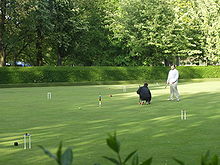
A croquet lawn at a club in Edinburgh, Scotland


San Francisco Botanical Garden lawn

A lawn is an area of soil-covered land planted with grasses or (rarely) other durable plants such as clover which are maintained at a short height with a lawnmower and used for aesthetic and recreational purposes. Common characteristics of a lawn are that it is composed only of grass species, it is subject to weed and pest control, it is subject to practices aimed at maintaining its green color (e.g., watering), and it is regularly mowed to ensure an acceptable length,[1] although these characteristics are not binding as a definition. Lawns ar e used around houses, apartments, commercial buildings and offices. Many city parks also have large lawn areas. In recreational contexts, the specialised names turf, pitch, field or green may be used, depending on the sport and the continent.

The term "lawn", referring to a managed grass space, dates to no earlier than the 16th century. Tied to suburban expansion and the creation of the household aesthetic, the lawn is an important aspect of the interaction between the natural environment and the constructed urban and suburban space.[2] In many suburban areas, there are bylaws in place requiring houses to have lawns and requiring the proper maintenance of these lawns. In some jurisdictions where there are water shortages, local government authorities are encouraging alternatives to lawns to reduce water use.

Contents

1 Etymology

2 History

2.1 Origins

2.2 The English lawn

2.3 Middle class pursuit

2.4 United States

2.5 Ame rican lawn culture

2.6 Australia

3 Uses

4 Types of lawn plants

4.1 Grasses

4.1.1 Cool season grasses

4.1.2 Warm season grasses

4.2 Grass alternatives

4.3 Ground cover alternatives

5 Lawn care and maintenance

5.1 Planting and seeding

5.2 Fertilizers and chemicals

5.3 Mowing and other maintenance practices

6 Social impacts

7 Environmental concerns

7.1 Water conservation

7.2 Chemicals

7.3 Decreasing environmental impact

8 See also

8.1 Lawns

8.2 Gardening

8.3 Others

9 References

10 Further reading

11 External links

Etymology

Lawn is a cognate of llan which is derived from the Common Brittonic word landa (Old French: launde) that originally means heath, barren land, or clearing.[3][4]

History

Origins


Gardens of the Chteau de Vaux-le-Vicomte, designed by Andr Le Ntre at Versailles.

Lawns may have originated as grassed enclosures within early medieval settlements used for communal grazing of livestock, as distinct from fields reserved for agriculture. The word "laune" is first attested in 1540,[5] and is likely related to the Celtic Brythonic word lan/llan/laun, which has the meaning of enclosure, often in relation to a place of worship.

Lawns became popular with https://www.youtube.com/watch?v=uRbW3ayDWVQ the aristocracy in nort hern Europe from the Middle Ages onward. The early lawns were not always distinguishable from pasture fields. It is speculated that the association between the word "pasture" and biblical mentions made lawns a cultural affinity for some. The damp climate of maritime Western Europe in the north made lawns possible to grow and manage. They were not a part of gardens in other regions and cultures of the world until contemporary influence.[6]

Before the invention of mowing machines in 1830, lawns were managed very differently. They were an element of wealthy estates and manor houses, and in some places were maintained by the labor-intensive methods of scything and shearing. In most situations, they were also pasture land maintained through grazing by sheep or other livestock. Areas of grass grazed regularly by rabbits, horses or sheep over a long period often form a very low, tight sward similar to a modern lawn. This was the original meaning of the word "lawn", and the term can still be found in place names. Some forest areas where extensive grazing is practiced still have these seminatural lawns. For example, in the New Forest, England, such grazed areas are common, and are known as lawns, for example Balmer Lawn. Lawns similar to those of today first appeared in France and England in the 1700s when Andr Le Ntre designed the gardens of Versailles that included a small area of grass called the tapis vert, or "green carpet".

The English lawn


Capability Brown's landscape design at Badminton House.

It was not until the 17th and 18th century that the garden and the lawn became a place created first as walkways and social areas. They were made up of meadow plants, such as camomile, a particular favorite. In the early 17th century, the Jacobean epoch of gardening began; during this period, the closely cut "English" lawn was born. By the end of this period, the English lawn was a symbol of status of the aristocracy and gentry; it showed that the owner could afford to keep land that was not being used for a building, or for food production.

In the early 18th century, landscape gardening for the aristocracy entered a golden age, under the direction of William Kent and Lancelot "Capability" Brown. They refined the English landscape garden style with the design of natural, or "romantic", estate settings for wealthy Englishmen.[7] Brown, remembered as "England's greatest gardener", designed over 170 parks, many of which still endure. His influence was so great that the contributions to the English garden made by his predecessors Charles Bridgeman and William Kent are often overlooked.[8]

His work still endures at Croome Court (where he also designed the house), Blenheim Palace, Warwick Castle, Harewood House, Bowood House, Milton Abbey (and nearby Milton Abbas village), in traces at Kew Gardens and many other locations.[9] His style of smooth undulating lawns which ran seamlessly to the house and meadow, clumps, belts and scattering of trees and his serpentine lakes formed by invisibly damming small rivers, were a new style within the English landscape, a "gardenless" form of landscape gardening, which swept away almost all the remnants of previous formally patterned styles. His landscapes were fundamentally different from what they replaced, the well-known formal gardens of England which were criticised by Alexander Pope and others from the 1710s.[10]


1803 painting of the main elements of the English landscape garden.

The open "English style" of parkland first spread across Britain and Ireland, and then across Europe, such as the garden la franaise being replaced by the French landscape garden. By this time , the word "lawn" in England had semantically shifted to describe a piece of a garden covered with grass and closely mown.[11] Wealthy families in America during the late 18th century also began mimicking English landscaping styles. In 1780, the Shaker community began the first industrial production of high-quality grass seed in North America, and a number of seed companies and nurseries were founded in Philadelphia. The increased availability of these grasses meant they were in plentiful supply for parks and residential areas, not just livestock.[11]

Thomas Jefferson has long been given credit for being the first person to attempt an English-style lawn at his estate, Monticello, in 1806, but many others had tried to emulate English landscaping before he did. Over time, an increasing number towns in New England began to emphasize grass spaces. Many scholars link this development to the romantic and transcendentalist movements of the 19th century. These green commons were also heavily associated with the success of the Revolutionary War and often became the homes of patriotic war memorials after the Civil War ended in 1865.[11]

Middle class pursuit


The lawn at Kirkby Fleetham Hall, Yorkshire, circa 1889.

Before the mechanical lawnmower, the upkeep of lawns was possible only fo r the extremely wealthy estates and manor houses of the aristocracy. Labor-intensive methods of scything and shearing the grass were required to maintain the lawn in its correct state, and most of the land in England was required for more functional, agricultural purposes.

This all changed with the invention of the lawnmower by Edwin Beard Budding in 1830. Budding had the idea for a lawnmower after seeing a machine in a local cloth mill which used a cutting cylinder (or bladed reel) mounted on a bench to trim the irregular nap from the surface of woollen cloth and give a smooth finish.[12] Budding realised that a similar device could be used to cut grass if the mechanism was mounted in a wheeled frame to make the blades rotate close to the lawn's surface. His mower design was to be used primarily to cut the lawn on sports grounds and extensive gardens, as a superior alternative to the scythe, and he was granted a British patent on 31 August 1830.[13]

In an agreement be tween John Ferrabee and Edwin Budding, Ferrabee paid the costs of development and acquired rights to manufacture, sell and license other manufacturers in the production of lawn mowers. Budding went into partnership with a local engineer, John Ferrabee, and together they made mowers in a factory at Thrupp near Stroud.[14] They allowed other companies to build copies of their mower under license, the most successful of these, was Ransomes, Sims & Jefferies of Ipswich which began mower production as early as 1832.[15]


The first petrol-powered lawnmower, 1902.

However, his mod el had two crucial drawbacks. It was immensely heavy (it was made of cast iron) and difficult to manoeuvre in the garden, and did not cut the grass very well. The blade would often spin above the grass uselessly.[15] It took ten more years and further innovations, including the advent of the Bessemer process for the production of the much lighter alloy steel and advances in motorization such as the drive chain, for the lawnmower to become a practical proposition. Middle-class families across the country, in imitation of aristocratic landscape gardens, began to grow finely trimmed lawns in their back gardens.

In the 1850s, Thomas Green of Leeds introduced a revolutionary mower design called the Silens Messor (meaning silent cutter), which used a chain to transmit power from the rear roller to the cutting cylinder. The machine was much lighter and quieter than the gear driven machines that preceded them, and won first prize at the first lawn mower trial at the London Horticultu ral Gardens.[15] Thus began a great expansion in the lawn mower production in the 1860s. James Sumner of Lancashire patented the first steam-powered lawn mower in 1893.[16] Around 1900, Ransomes' Automaton, available in chain- or gear-driven models, dominated the British market. In 1902, Ransomes produced the first commercially available mower powered by an internal combustion gasoline engine. JP Engineering of Leicester, founded after World War I, invented the first riding mowers.


From the 1860s, the cultivation of lawns, especially for sports, became a middle-class obsession in England. Pictured, a lawnm ower advertisement from Ransomes.

This went hand-in-hand with a booming consumer market for lawns from the 1860s onward. With the increasing popularity of sports in the mid-Victorian period, the lawn mower was used to craft modern-style sporting ovals, playing fields, pitches and grass courts for the nascent sports of football, lawn bowls, lawn tennis and others.[17] The rise of Suburbanisation in the interwar period was heavily influenced by the garden city movement of Ebenezer Howard and the creation of the first garden suburbs at the turn of the 20th century.[18] The garden suburb, developed through the efforts of social reformer Henrietta Barnett and her husband, exemplified the incorporation of the well manicured lawn into suburban life.[19] Suburbs dramatically increased in size. Harrow Weald went from just 1,500 to over 10,000 while Pinner jumped from 3,00 to over 20,000. During the 1930s, over 4 million new suburban houses were built and the 'suburban revolution' had made England the most heavily suburbanized country in the world by a considerable margin.[20]

Lawns began to proliferate in America from the 1870s onwards. As more plants were introduced from Europe, lawns became smaller as they were filled with flower beds, perennials, sculptures, and water features.[21] Eventually the wealthy began to move away from the cities into new suburban communities. In 1856, an architectural book was published to accompany the development of the new suburbia that placed importance on the availability of a grassy space for children to play on and a space to grow fruits and vegetables that further imbued the lawn with cultural importance.[11] Lawns began making more appearances in development plans, magazine articles, and catalogs.[22] The lawn became less associated with being a status symbol, instead giving way to a landscape aesthetic. Improvements in the lawn mower and water supply enabled the spread of lawn culture from the Northeast to the South where the grass grew more poorly.[11] This in combination with setback rules which required all homes to have a 30-foot gap between the structure and the sidewalk meant that the lawn had found a specific place in suburbia.[21]

United States

Lawn seating


A Memorial Day concert on the west lawn of the U.S. Capitol Building

Prior to European colonization, the grasses on the East Coast of North America were mostly broom straw, wild rye, and marsh grass. As Europeans moved into the region, it was noted by colonists in New England, more than others, that the grasses of the New World were inferior to those of England and that their livestock seemed to receive less nutrition from it. In fact, once livestock brought overseas from Europe spread throughout the colonies, much of the native grasses of New England disappeared, and an inventory list from the 17th century noted supplies of clover and grass seed from England. New colonists were even urged by their country and companies to bring grass seed with them to North America. By the late 17th century, a new market in imported grass seed had begun in New England.[11]

Much of the new grasses brought by Europeans spread quickly and effectively, often ahead of the colonists. One such species, Bermuda grass (Cynodon dactylon), became the most important pasture grass for the southern colonies.

Kentucky Bluegrass ( Poa pratensis) is a grass native to Europe or the Middle East. It was likely carried to Midwestern United States in the early 1600s by French missionaries and spread via the waterways to the region around Kentucky. However, it may also have spread across the Appalachian mountains after an introduction on the east coast. Kentucky Bluegrass is now one of the top three pasture grasses in the United States and the most desirable species of grass for lawns.

Farmers at first continued to harvest meadows and marshes composed of indigenous grasses until they became overgrazed. These areas quickly fell to erosion and were overrun with less favorable plant life. Soon, farmers began to purposefully plant new species of grass in these areas, hoping to improve the quality and quantity of hay to provide for their livestock as native species had a lower nutritive value. While Middle Eastern and Europeans species of grass did extremely well on the East Coast of North America, it was a number of grasses from the Mediterranean that dominated the Western seaboard. As cultivated grasses became valued for their nutritional benefits to livestock, farmers relied less and less on natural meadows in the more colonized areas of the country. Eventually even the grasses of the Great Plains were overrun with European species that were more durable to the grazing patterns of imported livestock.[11] A pivotal factor in the spread of the lawn in America was the passage of legislation in 1938 of the 40-hour work week. Until then, Americans had typically worked half days on Saturdays, leaving little time to focus on their lawns. With this legislation and the housing boom following the Second World War, managed grass spaces became more commonplace.[21] The creation in the early 20th century of country clubs and golf courses completed the rise of lawn culture.[11]

American lawn culture

Lawn monoculture was a reflection of more than an interest in offsetting depreciation, it propagated the homogeneity of the suburb itself. Although lawns had been a recognizable feature in English residences since the 19th century, a revolution in industrialization and monoculture of the lawn since the Second World War fundamentally changed the ecology of the lawn. Intensive suburbanization both concentrated and expanded the spread of lawn maintenance which meant increased inputs in not only petrochemicals, fertilizers, and pesticides, but also natural resources like water.[2][11][21]

Front lawns became standardized in the 1930s when, over time, specific aspects such as grass type and maintenance methods became popular. The lawn-care industry boomed, but the Great Depression of the 1930s and in the period prior to World War II made it difficult to maintain the cultural standards that had become heavily associated with the lawn due to grass seed shortages in Europe, America's main supplier. Still, seed distributors such as Scotts Miracle-Gro Company in the United S tates encouraged families to continue to maintain their lawns, promoting it as a stress-relieving hobby. During the war itself, homeowners were asked to maintain the appearances of the home front, likely as a show of strength, morale, and solidarity. After World War II, the lawn aesthetic once again became a standard feature of North America, bouncing back from its minor decline in the decades before with a vengeance, particularly as a result of the housing and population boom post-war.[11]

The G.I. Bill in the United States let American ex-servicemen buy homes without providing a down payment, while the Federal Housing Administration offered lender inducements that aided the reduction of down payments for the average American from 30% to as little as 10%. These developments made owning your own home cheaper than renting, further enabling the spread of suburbia and its lawns.[21]

Levittown, New York was the beginning of the industrial suburb in the 20th Century, and by proxy the industrial lawn. Between 1947 and 1951, Abraham Levitt and his sons built more than seventeen thousand homes, each with its own lawn. Abraham Levitt wrote "No single feature of a suburban residential community contributes as much to the charm and beauty of the individual home and the locality as well-kept lawns". Landscaping was one of the most important factors in Levittown's success - and no feature was more prominent than the lawn. The Levitts understood that landscaping could add to the appeal of their developments and claimed that, "increase in values are most often found in neighborhoods where lawns show as green carpets" and that, over the years, "lawns trees and shrubs become more valuable both esthetically and monetarily".[23] During 1948, the first spring that Levittown had enjoyed, Levitt and Sons fertilized and reseeded all of the lawns free of charge.[21]

The economic recession that began in 2008 has resulted in many communities worldwide to dig up the ir lawns and plant fruit and vegetable gardens. This has the potential to greatly change cultural values attached to the lawn, as they are increasingly viewed as environmentally and economically unviable in the modern context.[24]

Australia

The appearance of the lawn in Australia followed closely after its establishment in North America and parts of Europe. Lawn was established on the so-called "nature strip" by the 1920s and was common throughout the developing suburbs of Australia. This term is uniquely Australian, alluding, perhaps, to man's desire to control nature. By the 1950s, the Australian-designed Victa lawn mower was being used by the many people who had turned pastures into lawn and was also being exported to dozens of countries.[25] Prior to the 1970s, all brush and native species were stripped from a development site and replaced with lawns that utilized imported plant species. Since the 1970s there has been an interest in using indigenous species for law ns, especially considering their lower water requirements.[26] Lawns are also established in garden areas as well as used for the surface of sporting fields.

Over time, with consideration to the frequency of droughts in Australia, the movement towards "naturalism", or the use of indigenous plant species in yards, was beneficial. These grasses were more drought resistant than their European counterparts, and many who wished to keep their lawns switched to these alternatives or allowed their green carpets to revert to the indigenous scrub in an effort to reduce the strain on water supplies.[24] However, lawns remain a popular surface and their practical and aesthetically pleasing appearance reduces the use of water-impervious surfaces such as concrete. The growing use of rainwater storage tanks has improved the ability to maintain them.

Following recent droughts, Australia has seen a change to predominately warm-season turfgrasses, particularly in the southern states lik e New South Wales and Victoria which are predominately temperate climates within urban regions. The more drought tolerant grasses have been chosen by councils and homeowners for the choice of using less water compared to cool-season turfgrasses like fescue and ryegrass. Mild dormancy seems to be of little concern when high-profile areas can be oversown for short periods or nowadays, turf colourants (fake green) are extremely popular.

Within Australia it is reported that there are nearly 400 turf farms.[27] Knowing which farm is currently selling what turf variety is difficult. However, in 2016 an independent web site called TurfFinder was developed to assist homeowners and professional turf managers in choosing the appropriate turfgrass that meets their needs. The web site lists generic and technical information on over 100 warm- and cool-season turfgrasses and provides the location of reputable turf producers from across Australia that sell these turf varieties.

Uses< br>


A newly seeded, fertilized and mowed lawn

Lawns are a common feature of private gardens, public landscapes and parks in many parts of the world. They are created for aesthetic pleasure, as well as for sports or other outdoor recreational use. Lawns are useful as a playing surface both because they mitigate erosion and dust generated by intensive foot traffic and because they provide a cushion for players in sports such as rugby, football, soccer, cricket, baseball, golf, tennis, hockey and lawn bocce.

Lawns and the resulting lawn clipping waste can be used as an ingredient in making compost and is also viewed as fodder, used in the production of lawn clipping silage which is fed to livestock[28][29] as a sustainable feed source.

Types of lawn plants

Lawns need not be, and have not always been, made up of grasses alone. Other plants for lawn-like usable garden areas are sedges, low herbs and wildflowers, and ground covers that can be walked upon.


The area on the right has not been mown since the previous autumn.

Thousands of varieties of grasses and grasslike p lants are used for lawns, each adapted to specific conditions of precipitation and irrigation, seasonal temperatures, and sun/shade tolerances. Plant hybridizers and botanists are constantly creating and finding improved varieties of the basic species and new ones, often more economical and environmentally sustainable by needing less water, fertilizer, pest and disease treatments, and maintenance. The three basic categories are cool season grasses, warm season grasses, and grass alternatives.

Grasses

Many different species of grass are currently used, depending on the intended use and the climate. Coarse grasses are used where active sports are played, and finer grasses are used for ornamental lawns for their visual effects. Some grasses are adapted to oceanic climates with cooler summers, and others to tropical and continental climates with hotter summers. Often, a mix of grass or low plant types is used to form a stronger lawn when one type does better in the warmer seasons and the other in the colder ones. This mixing is taken further by a form of grass breeding which produces what are known as cultivars. A cultivar is a cross-breed of two different varieties of grass and aims to combine certain traits taken from each individual breed. This creates a new strain which can be very specialised, suited to a particular environment, such as low water, low light or low nutrient.

Diagram of a typical lawn grass plant.

Diagram of a typical lawn grass plant.

Cool season grasses

Cool season grasses start growth at 5C (41F), and grow at their fastest rate when temperatures are between 10C (50F) and 25C (77F), in climates that have relatively mild/cool summers, with two periods of rapid growth in the spring and autumn.[30] They retain their color well in extreme cold and typically grow very dense, carpetlike lawns with relatively little thatch.

Conventional selections:

Bluegrass (Poa spp.)

Bentgrass (Agrostis spp.)

Ryegrasses (Lolium spp.)

Fescues (Festuca spp., hybrids, and cultivars)

Native plant regional selections (for taller lawns):

Red fescues (Festuca rubra)

Feather reed grass (Calamogrostis spp.)

Tufted hair grass (Deschampsia spp.)

Cluster fescue (Festuca paradoxa spp.)

Warm season grasses

Warm season grasses only start growth at temperatures above 10C (50F), and grow fastest when temperatures are between 25C (77F) and 35C (95F), with one long growth period over the spring and summer (H uxley 1992). They often go dormant in cooler months, turning shades of tan or brown. Many warm season grasses are quite drought tolerant, and can handle very high summer temperatures, although temperatures below -15C (5F) can kill most southern ecotype warm season grasses. The northern varieties, such as buffalograss and blue grama, are hardy to 45C (113F).

Zoysiagrass (Zoysia spp.)

Bermudagrass (Cynodon spp.)

St. Augustine grass

Bahiagrass (Paspalum)

Centipedegrass (Eremachloa)

Carpetgrass (Axonopus)

Buffalograss (drought tolerant)

Grama grass

Grass alternatives

Carex species and cultivars are well represented in the horticulture industry as 'sedge' alternatives for 'grass' in mowed lawns and garden meadows. Both low-growing and spreading ornamental cultivars and native species are used in for sustainable landscaping as low-maintenance and drought-tolerant grass replacements for lawns and garden meadows. wildland habitat restoration projects and natural landscaping and gardens use them also for 'user-friendly' areas. The J. Paul Getty Museum has used Carex pansa (meadow sedge) and Carex praegracilis (dune sedge) expansively in the Sculpture Gardens in Los Angeles.[31]

Some lower sedges used are:

Carex caryophyllea (cultivar 'The Beatles')

C. divulsa (Berkeley sedge)[31]

C. glauca (blue sedge) (syn. C. flacca)

C. pansa (meadow sedge)[31]


C. praegracilis (dune sedge)[31]

C. subfusca (mountain sedge)[31]

C. tumulicola (foothill sedge) (cultivar 'Santa Cruz Mnts. selection')[31]

C. uncifolia (ruby sedge)

Ground cover alternatives


One of ground cover plants, common bearberry

Some lawns are replaced with low ground covers, such as creeping thyme, camomile, Lippia, purple flowering Mazus, grey Dymondia, creeping sedums, and creeping jenny.[32] An example of this is the floral lawn in Avondale Park. Other alternatives to lawns include meadows, drought-tolerant xeriscape gardens, natural landscapes, native plant habitat gardens, paved Spanish courtyard and patio gardens, butterfly gardens, rain gardens, tapestry lawn and kitchen gardens. Trees and shrubs in close proximity to lawns provide habitat for birds in traditional, cottage and wildlife gardens.

Lawn care and maintenance

Seasonal lawn establishment and care varies depending on the climate zone and type of lawn grown.

Planting and seeding


Broadcast spreaders can be attached to tractors or ATVs to spread seed or fertilizer


Aeration is one method used to maintain a lawn

Early autumn, spring, and early summer are the primary seasons to seed, lay sod (turf), plant 'liners', or 'sprig' new lawns, when the soil is warmer and air cooler. Seeding is the least expensive, but may take longer for the lawn to be established. Aerating just before planting/seeding may promote deeper root growth and thicker turf.

Sodding (American English), or turfing (British English), provides an almost instant lawn, and can be undertaken in most temperate climates in any season, but is more expensive and more vulnerable to drought until established. Hydroseeding is a quick, less expensive method of planting large, sloped or hillside landscapes. Some grasses and sedges are available and planted from 'liner' and 4-inch (100mm) containers, from 'flats', 'plugs' or 'sprigs', and are planted apart to grow together.

Lawncare.gif

Lawn growth, 20-hour time lapse

Fertilizers and chemicals

Various organic and inorganic or synthetic fertilizers are available, with instant or time-release applications. Pesticides, which includes biological and chemical herbicides, insecticides and fungicides are available. Consideration for their effects on the lawn and garden ecosystem and via runoff and dispersion on the surrounding environment, can constrain their use. For example, the Canadian province of Quebec and over 130 municipalities prohibit the use of synthetic lawn pesticides. In order for the lawn to grow and flourish, the soil must be prepared properly. If this step is overlooked as many do, the lawn will burn out as soon as it runs out of nutrients. [33][33] The Ontario provincial government promised on 24-2 September 2007 to also implement a province-wide ban on the cosmet ic use of lawn pesticides, for protecting the public. Medical and environmental groups support such a ban.[34] On 22-2 April 2008, the Provincial Government of Ontario announced that it will pass legislation that will prohibit, province-wide, the cosmetic use and sale of lawn and garden pesticides.[35] The Ontario legislation would also echo Massachusetts law requiring pesticide manufacturers to reduce the toxins they use in production.[36]

Sustainable gardening uses organic horticulture methods, such as organic fertilizers, biological pest control, beneficial insects, and companion planting, among other methods, to sustain an attractive lawn in a safe garden. An example of an organic herbicide is corn gluten meal, which releases an 'organic dipeptide' into the soil to inhibit root formation of germinating weed seeds. An example of an organic alternative to insecticide use is applying beneficial nematodes to combat soil-dwelling grubs, such as the larvae of chafer beetles. Th e Integrated Pest Management approach is a coordinated low impact approach.[37]

Mowing and other maintenance practices


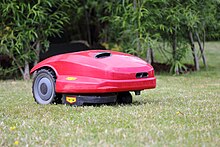
A typical lawn-mowing bot maintaining even and low grass.


Dethatching removes dead grass and decomposing materials that build up in a lawn


Lawn sweepers clean up debris from dethatching in addition to leaves, twigs, pine needles, etc.

Maintaining a rough lawn requires only occasional cutting with a suitable machine, or grazing by animals. Maintaining a smooth and closely cut lawn, be it for aesthetic or practical reasons or because social pressure from neighbors and local municipal ordinances requires it,[38] n ecessitates more organized and regular treatments. Usually once a week is adequate for maintaining a lawn in most climates. However, in the hot and rainy seasons of regions contained in hardiness zones greater than 8, lawns may need to be maintained up to two times a week.


Social impacts

The prevalence of the lawns in films such as Pleasantville and Edward Scissorhands alludes to the importance of the lawn as a social mechanism that gives great importance to visual representation of the American suburb as well as its practised culture. It is implie d that a neighbor, whose lawn is not in pristine https://www.amazon.com/Lawn-Garden-Sprinklers/b?ie=UTF8&node=553974 condition, is morally corrupt, emphasizing the role a well-kept lawn plays in neighborly and community relationships. In both of these films, green space surrounding a house in the suburbs becomes an indicator of moral integrity as well as of social and gender norms as lawn care has long been associated with men. These lawns also reinforce class and societal norms by subtly excluding minorities who may not have been able to afford a house in the suburbs with a lawn that was the symbolic representation of safety and stability.[39] The lawn as a reflection of someone's character and the neighborhood at large is not restricted to films, the same theme is evident in The Great Gatsby, a book written by American novelist F. Scott Fitzgerald. Character Nick Carraway rents the house next to Gats by's and fails to maintain his lawn according to West Egg standards. The rift between the two lawns troubles Gatsby to the point that he dispatches his gardener to mow Nick's grass and thereby create uniformity.[40]

Most lawn care equipment over the decades has been advertised to men, and companies have long associated good lawn care with good citizenship in their marketing campaigns. As well, the appearance of a healthy lawn was meant to imply the health of the man taking care of it; controlled weeds and strict boundaries became a practical application of the desire to control nature, as well as an expression of control over their personal lives once working full-time became central to suburban success. Women were encultured over time to view the lawn as part of the household, as an essential furnishing, and to encourage their husbands to maintain a lawn for the family and community reputation.[11]

During World War II, women became the focus of lawn-care companies in the absence of their husbands and sons. The lawn was promoted as a necessary means by which women could help support their male family members and American patriotism as a whole. The image of the lawn changed from focusing on https://www.youtube.com/watch?v=uRbW3ayDWVQ technology and manhood to emphasizing aesthetic pleasure and the health benefits derived from its maintenance; it was assumed that women would not respond positively to images of efficiency and power. The language of these marketing campaigns still intended to imbue the female population with notions of family, motherhood, and the duties of a wife; it has been argued that this was done so that it would be easier for men returning from war to resume the roles their wives had taken over in their absence. This was especially apparent in the 1950s and 1960s, when lawn-care rhetoric emphasized the lawn as a husband's responsibility and as a pleasurable hobby when he retired.[11]

The lawn aesthetic in Europe and Australia seems to exhibit the same cultural tendencies as a representation of order, power over nature, patriotism, and suburban family life while still adhering to other gender constructs present throughout the world's suburbs. However, there are differences in the particulars of lawn maintenance and appearance, such as the length of the grass, species (and therefore its color), and mowing.[26][41]

Environmental concerns

Greater amounts of chemical fertilizer and pesticides are used per acre of lawn than on an equivalent acre of cultivated farmland,[42] and the continued use of these products has been associated with environmental pollution, disturbance in the lawn ecosystem, and increased health risks to the local human population.[43]

Other concerns, criticisms, and ordinances regarding lawns come from the environmental consequences:

Lawns can reduce biodiversity, especially when the lawn covers a large area. Lawns - particularly in the United States - may be composed of introduced species not native to an area, which can produce a habitat that supports a reduced number of species.[44]

Lawn maintenance may use inorganic fertilizers, synthetic pesticides, herbicides, and fungicides, which can harm the environment. The United States Environmental Protection Agency has estimated nearly 70,000,000 pounds (32,000,000kg) of active pesticide ingredients are used on suburban lawns each year in the United States.[45] It has also been estimated that more herbicides are applied per acre of lawn than are used by most farmers to grow crops.[21]For example, Sweden, Denmark, Norway, Kuwait, and Belize have placed restrictions on the use of the herbicide 2,4-D.

It has been estimated that nearly 17 million gallons of gasoline are spilled each summer while re-fueling garden and lawn-care equipment in the United States; approximately 50% more than that spilled during the Exxon Val dez incident.[21]

The use of pesticides and fertilizers, requiring fossil fuels for manufacturing, distribution, and application, have been shown to contribute to global warming, whereas sustainable organic techniques have been shown to help reduce global warming.[46]


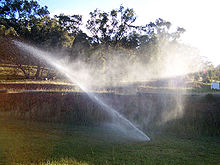
A lawn sprinkler

Water conservation

Maintaining a green lawn sometimes requires large amounts of water. This is not normally a problem in the temperate British Isles, where the concept of the lawn originated, as natural rainfall is usually sufficient to maintain a lawn's health, although in times of drought hosepipe bans may be implemented by the water suppliers.[47] The exportation of the lawn ideal to more arid regions of the world, however, such as the U.S. Southwest and Australia, has crimped already scarce water resources in such areas, requiring larger, more environmentally invasive water supply systems. Grass typically goes dormant during cold, winter months, and turns brown during hot, dry summer months, thereby reducing its demand for water. Many property owners consider this "dead" appearance unacceptable, and therefore increase watering during the summer months. Grass can also recover quite well from a drought.

In the United States, 50 to 70% of residential water is used for landscaping, most of it to water lawns.[45] A 2005 NASA study "conservatively" estimated there was 128,000 square kilometres (49,000sqmi; 32,000,000 acres) of irrigated lawn in the US, three times the area of irrigated corn.[48]

"

That means about 200 gallons of f resh, usually drinking-quality water per person per day would be required to keep up our nation's lawn surface area.

"

It is possible that lawn maintenance could come at the expense of precious resources, especially when faced with extreme weather conditions. This situation is described in Water in Australia by David Ingle Smith, who observed in 1995 data that under extreme conditions during summer drought periods, up to 90% of the water used in Canberra, Australia was applied to lawns.[49]

Chemicals

An increased concern from the general public over pesticide and fertilizer use and their associated health risks, combined with the implementation of the legislation, such as the US Food Quality Protection Act, has resulted in the reduced presence of synthetic chemicals, namely pesticides, in urban landscapes such as lawns in the late 20th century.[50] Many of these concerns over the safety and environmental impact of some of the synthetic fertilizers and pes ticides has led to their ban by the United States Environmental Protection Agency and many local governments.[43] The use of pesticides and other chemicals to care for lawns has also led to the death of nearly 7 million birds each year, a topic that was central to Silent Spring by the conservationist Rachel Carson.[21]

Decreasing environmental impact

In the United States, lawn heights are generally maintained by gasoline-powered lawnmowers, which contribute to urban smog during the summer months. The EPA found, in some urban areas, up to 5% of smog was due to small gasoline engines made before 1997, such as are typically used on lawnmowers. Since 1997, the EPA has mandated emissions controls on newer engines in an effort to reduce smog.[51]

A 2010 study seemed to show lawn care inputs were balanced by the carbon sequestration benefits of lawns, and they may not be contributors to anthropogenic global warming.[52][53]

However, lawns with high maintenance ( mowing, irrigation, and leaf blowing) and high fertilization rates have a net emission of carbon dioxide and nitrous oxide that have large global warming potential.[54]

With the use of ecological techniques including organic lawn management, the impact of lawns can be reduced. Such methods include the use of native grasses, sedges, and low herbs; higher mowing techniques; low volume irrigation, 'grasscycling' grass clippings in place; an integrated pest management program; exclusive organic fertilizer and compost use; and including a variety of trees, shrubs, perennials, and other plants surrounding the lawn. A positive benefit of a healthy lawn is it filters contaminants and prevents runoff and erosion of bare soil.

Replacing turf grass with low-maintenance groundcovers or employing a variety of low-maintenance perennials, trees and shrubs[44] can be a good alternative to traditional lawn spaces, especially in hard-to-grow or hard-to-mow areas, as it ?an reduce mainte nance requirements, associated pollution and offers higher aesthetic and wildlife value.[55]

See also

Lawns

Grasses

Grasslands

Lawn topics

Lawn sweeper

Lawn aerator

Organic lawn management

Gardening

Gardening

Organic gardening

Organic horticulture

Sustainable gardening

Sustainable landscaping

List of organic gardening and farming topics with links

Others

bacterial lawn

References

^ Ripmeester, Michael. "Lawn." Encyclopedia of Urban Studies. Ed. Ray Hutchison. Thousand Oaks, CA: SAGE, 2009. 441-45. SAGE Reference Online. Web. 2 Apr 2012.

^ a b Robbins, Paul. Lawn People: How Grasses, Weeds, and Chemicals Make Us Who We Are. Philadelphia: Temple University Press, 2007.

^ "Online Etymology Dictionary". Etymonline.com. 10 June 1927. Retrieved 11 June 2013.

^ "laund". Oxford English Dictionary. Retrieved 27 March 2013.

^ "Etymolo gy for "lawn"". Etymonline. Retrieved 5 June 2015.

^ Hostetler, Mark E. (2012-02-07). The Green Leap: A Primer for Conserving Biodiversity in Subdivision Development. University of California Press. ISBN9780520271104.

^ "Lancelot Brown". Encyclopdia Britannica, Encyclopdia Britannica Online. Encyclopdia Britannica Inc. 2007. Retrieved 12 March 2012.

^ Walpole, Horace (1905) [1780]. On Modern Gardening. Canton, Pa.: Kirgate Press. at Internet Archive

^ "Lancelot 'Capability' Brown (1716-1783)". Kew History & Heritage. Kew Gardens. Archived from the original on 8 October 2012. Retrieved 16 March 2012.

^ Peter Willis, "Capability Brown in Northumberland" Garden History 9.2 (Autumn, 1981, pp. 157-183)

^ a b c d e f g h i j k l Jenkins, Virginia S. The Lawn: A History of an American Obsession. Smithsonian Institution, 1994.

^ "Gardening - Design - Georgian and Regency". BBC. Retrieved 24 May 2009.

^ US RE 8560, Passmore, Everett G., "Improvement in Lawn-Mowers", published 23 February 1869, issued 28 January 1879; see pg 1, col 2. For a copy, see Google Patents copy. This source indicates the patent number as "6,080". According to "British patent numbers 1617 - 1852 (old series)", the patent number was assigned sometime after 1852 and took the form of "6080/1830".

^ "People at the cutting edge: lawnmower designers". Parks & Gardens UK (University of York/Association of Gardens Trusts). Retrieved 24 May 2009.

^ a b c The Old Lawnmower Club. "Mower History". The Old Lawnmower Club. Retrieved 23 April 2011.

^ "The History of the LawnMower". Thelawnmower.info. Retrieved 23 April 2011.

^ Australian Broadcasting Corporation's Radio National Ockham's Razor, first broadcast 6 June 2010.

^ "The suburban aspiration in England since 1919". Contemporary British History. 14: 151-174. doi:10.1080/13619460008581576.

^ "Henrietta Barnett and the Beginnings of the Suburb". Archived from the original on 6 December 2013.

^ "Suburban Ideals on England's Interwar Council Estates". Retrieved 17 December 2012.

^ a b c d e f g h i Steinberg, T. (2006). American Green, The Obsessive Quest for the Perfect Lawn. W.W. Norton & Co. ISBN 0-393-06084-5.

^ Influence of catalogs: See America's Romance with the English Garden by Thomas J. Mickey, 2013. Cited at [1]

^ Teysott, Georges (1 June 1999). The American Lawn. Princeton Architectural Press. p.18. ISBN1568981600.

^ a b Trudgill, Stephan; Jeffery, Angus; Parker, John (2010). "Climate Change and the Resilience of the Domestic Lawn". Applied Geography. 30 (1): 177-190. doi:10.1016/j.apgeog.2009.08.002.

^ Wood, Richard V. (2002). "Richardson, Mervyn Victor (1894 - 1972)". Australian Dictionary of Biography. Canberra: Australian National University. Retrieved 2007-08-25.

^ a b Hogan, Trevor. " 'Nature Strip': Australian Suburbia and the Enculturation of Nature." Thesis Eleven 74:1 (2003): 54-75.

^ Australian Bureau of Statistics, 1998

^ "Making Silage from Lawn Clippings". Grit. Retrieved 2016-01-05.

^ Logsdon, Gene (2004). All Flesh Is Grass. Ohio: Swallow Press. pp.Chapter 20. ISBN978-0-8040-1068-9.

^ Huxley, A., ed. (1992). Lawns. In New RHS Dictionary of Gardening 3: 26-33. Macmillan. ISBN 0-333-47494-5

^ a b c d e f Bornstein, Carol, Fross, David, and O'Brien, Bart; 'California Native Plants for the Garden;' Cachuma Press, Los Olivos, CA; 2005; ISBN 0-9628505-8-6, 0-9628505-9-4. pp. 74-5.

^ Lunn, Matthew (7 September 2004). "Fact Sheet: Lawn Alternatives". Gardening Australia. Retrieved 16 September 2009.

^ a b Christie, Mike (13 March 2007). "Private Property Pesticide By-laws In Canada" (PDF). The Coalition for a Healthy Ottawa.

^ "Why We Support a Province-wide Ban on Cosmetic Pesticides" (PDF).

^ Mittelstaedt, Martin (22 April 2008). "Ontario to prohibit cosmetic-use pesticides". Globe an d Mail. Archived from the original on 28 August 2008.

^ Benzie, Robert (22 April 2008). "Pesticide ban set to grow". Toronto Star.

^ UC Statewide Integrated Pest Management Program. access date: 25 May 2010

^ "High Weed/Grass Complaint Process". City of Akron, Ohio.

^ Dickinson, Greg (2006). "The Pleasantville Effect: Nostalgia and the Visual Framing of (White) Suburbia". Western Journal of Communication. 70 (3): 212-233. doi:10.1080/10570310600843504.

^ Fitzgerald, F. Scott. The Great Gatsby. New York: Charles Scribner's Sons, 1925.

^ Sedgman, K (1997). "Cutting Grass: In Search of the Australian Male". Australian and New Zealand Journal of Family Therapy. 18 (3): 143-147. doi:10.1002/j.1467-8438.1997.tb00284.x.

^ Coates, Peter (2004). "Emerging from the Wilderness: (or, From Redwoods to Bananas): Recent Environmental History in the United States and the Rest of the Americas". Environment and History. 10: 407-38. doi:10.3197/09673400 42772676.

^ a b Alumai, Alfred. "Urban Lawn Management: Addressing the Entomological, Agronomic, Economic, and Social Drivers." PhD., Ohio State University, 2008.

^ a b Rebecca Pineo. Susan Barton. Turf Grass Madness: Reasons to Reduce the Lawn in Your Landscape

^ a b "Cut Your Lawn - In Half!". National Wildlife Federation.

^ Sayre, Laura. "Organic farming combats global warming--big time". Rodale Institute.

^ "Hosepipe ban". Retrieved 21 January 2015.

^ Milesi, Cristina; S.W. Running; C.D. Elvidge; J.B. Dietz; B.T. Tuttle; R.R. Nemani (8 November 2005). "Mapping and modeling the biogeochemical cycling of turf grasses in the United States". Environmental Management. 3: 426-438. doi:10.1007/s00267-004-0316-2. Retrieved 5 November 2010.

^ David Ingle Smith (1998). Water in Australia: Resources and Management. Oxford University Press, Melbourne

^ Alumai, Alfred; Salminen, Seppo O.; Richmond, Douglas S; Cardina, John; Grewal, Parw inder S. (2009). "Comparative Evaluation of Aesthetic, Biological, and Economic Effectiveness of Different Lawn Management Programs". Urban Ecosyst. 12: 127-144. doi:10.1007/s11252-008-0073-8.

^ "Answers to Commonly Asked Questions from Dealers and Distributors" (PDF). U.S. EPA. August 1998.

^ "Lawns may contribute to global warming" by Judy Lowe, Christian Science Monitor, 22 January 2010.

^ "Retrieved 17 May 2010". sciencedaily.com.

^ Townsend-Small, Amy; Czimczik, Claudia (March 2010). "Correction to "Carbon sequestration and greenhouse gas emissions in urban turf"". Geophysical Research Letters. 37 (http://www.agu.org/journals/gl/gl1006/2010GL042735/2010GL042735.pdf). Bibcode:2010GeoRL..37.6707T. doi:10.1029/2010GL042735. Retrieved 15 March 2012.

^ Rebecca Pineo, Botanic Gardens Intern Susan Barton, Extension Specialist. Groundcover Alternatives to Turf Grass

Further reading

Bormann, F. Herbert, et al. (1993) Redesigning the Ameri can Lawn.

Huxley, A., ed. (1992). New RHS Dictionary of Gardening. Lawns: Ch. 3: pp.26-33. Macmillan. ISBN 0-333-47494-5.

Jenkins, V. S. (1994). The Lawn: A History of an American Obsession. Smithsonian Books. ISBN 1-56098-406-6.

Steinberg, T. (2006). American Green, The Obsessive Quest for the Perfect Lawn. W.W. Norton & Co. ISBN 0-393-06084-5.

Wasowski, Sally and Andy (2004). Requiem for a Lawnmower.

External links

Media related to Lawns at Wikimedia Commons



Wikisource has the text of the 1920 Encyclopedia Americana article Lawns.

"Planting and care of Lawns" from the UNT Govt. Documents Dept.

Integrated Pest Management Program: website & search-engine

Lawn Care University at Michigan State University

"EPA Management of Polluted Runoff: Nonpoint Source Pollution" (includes mismanagement of lawns problems.)

v

t

e

Lawn and garden ornaments

Lawn

Bird bath

Bathtub Madonna

Concrete Aboriginal

Concrete goose

Garden gnome

Lawn jockey

Plastic flamingo

Suncatcher

Whirligi g

Yard globe

Garden gnome with wheelbarrow-20051026.jpg

Garden

Puteal

Suikinkutsu

Sundial

Wind chime

Wishing well

Authority control

NDL: 00570873


Retrieved from "https://en.wikipedia.org/w/index.php?title=L awn&oldid=780031163"

https://en.wikipedia.org/wiki/Lawn

Sunday, 14 May 2017

Landscape Paper-101 - InfoBarrel

Use landscape-paper where you want to kill weeds. Cover the landscape-paper with mulch; the paper rots down after a year, allowing you to hoe the ground to keep those weeds under control.

Some weeds need light to germinate, to start growing. All plants need light to keep growing. Even perennial, deep-rooted weeds like dock weed will exhaust their stored food supply and die if they cannot photosynthesise because light is excluded.

Mulch does a good job of excluding any light; it also stops wind blown seeds from reaching the ground and rooting. Mulch however will not stop deep-rooted weeds from growing through it.

The mulch needs something underneath if it is to have any chance of stopping dock weed or dandelions. Weed control fabric is designed to do that job. It does so very well, but weed control fabric allows wind blown seeds to put roots down, through it, to the soil. These weeds cannot then be removed by hoeing, because the fabric stops the hoe cutting off th e weed just below ground level.

landscape-paper is a new, lower cost, alternative to weed control fabric.

You roll out the landscape-paper onto your vegetable or flower garden. You cut 3 inch diameter holes in it and plant your annuals, cabbages and onions through the holes. Cover https://www.youtube.com/watch?v=kjreVlmEbis the landscape-paper with mulch and you have an attractive looking and totally weed-free vegetable garden or annual border.

landscape-paper comes in rolls 3 feet wide and 25 feet long. It is a pale brown color and it is biodegradable. The paper only lasts one season, but its low cost means that replacing it next season is no big deal.

For those who are growing organically landscape-paper is certified as suitable for growing organic vegetables because it contains no bleach or artificial additives.


If landscape-paper is not available where you live there are similar alternatives you might consider using.

Woodchip wallpaper is the first alternative, low cost, non-bleached paper with splinters stuck in it. It will cover the ground in exactly the same way and rot down into the soil after a year. Wallpaper rolls are only about 2 feet wide though, so http://roadsidethoughts.com/pa/ringing-rock-gardens-xx-montgomery-cemeteries.htm by the time you have done more overlapping than with the wider landscape-paper your savings will be minimal .

The paper https://www.youtube.com/watch?v=kjreVlmEbis underlay designed for underneath carpets might be a better alternative. It has no splinters in it and it is usually 6 feet wide, meaning less is wasted through overlaps.


Sheets of newspaper will also do the same job of separating mulch from soil, but these will not stop deep-rooted weeds in the same way as the others will. Use color printed newspaper if you want them to rot down more slowly.

You can also use newspaper sheets where you are laying turf. Just put the newspaper down on top of the raked soil. Weigh them down with stones and leave them for a month. Most of the weeds will have died by the end of the month and you can just roll the turf out on top of the newspaper.

http://www.infobarrel.com/Landscape_Paper-101

Tuesday, 9 May 2017

The Different Types Of Landscaping


So you have decisive lastly to tackle that horrible yard, and you want to do more than hide some meadow and smart the hedges. It is no surprise that a well landscaped yard not only looks great, but can add rate and enjoyment to your home. It is also not a furtive that landscaping is hard work, time-consuming, and dear.

Before you get started it is important that you assess the kind of landscaping that your yard can espousal, and inspect your graph to govern the size of the fling. With your findings in thinker you can originate a landscaping intend and get to work. A good graph is important in landscaping because it is demanding to foresee the perfect artifact before you opening, and it is even more grim to undo over work if the completed job does not look like you had envisioned.


These is where landscaping software steps in; it allows you to intermix all the basics of your propose and show you how it will look, all before you move your first grain of dirt. Modern landscaping software has swayed that was unimaginable only a few tiny time ago. Nearly every facet of landscape figure can be planned, executed, and tested using landscaping software.

Using the software often starts by https://www.youtube.com/watch?v=XKWCB_3nMJg importing digital photographs of your home onto your notebook. Those photographs become the look on which you can analyze you're creative landscaping dreams. The landscaping software could often alter the photograph of your home into a three dimensional image where you can "amble or fly" through, or around your home to see the over produce before you even father. The ability to see the glossed invention adds an obvious attract to landscape software, but the way the software helps you in getting to that end is what makes it rightly amazing. The skin limited in advanced landscaping software can help the professional or amateur landscape creator chart and execute a top https://www.youtube.com/watch?v=XKWCB_3nMJg value landscape draft. The software could help take the apposite plants and vegetation for your climate and sunlight conditions, and it can even strut the "zones" of your yard that will be the most and least hospitable for the different kinds of plants. As if that was not enough, many software applications can exhib it your plants in diverse stages of tumor. You can see how your plants and trees will look the day you conceal them, and how they'll look in ten living as well. Not even your imagination has this kind of intensity and accuracy.


The lighting options found in landscaping software are also an important tool in your quest for a top score landscape outline. The software could not only show you what your home will look like during the day or night, it can cast darkness on your acreage to simulate your home's look during every conceivable lighting clause. Using this technology, you can finish the best locations for artificial lighting, and even decide what altitude of brightness will best accentuate your landscape's skin, all with the click of a mouse.

Landscaping software could help you diagram more than plants and lighting. You can "idea" decks and patios, ensconce irrigation systems, pack a millpond, originate a cascading waterfall, choose yard furniture, and photocopy the full thing out to show your friends. You can even mean a shopping inventory to help you grip your food and graph your expenses. Landscaping software provides the command to plan and visualize in a way that was never before doable, so the smart landscaper will be loyal to take help of all that landscaping software has to propose.


By: The Bodybuilding Trainer

Article Directory: http://www.articledashboard.com

Visit the Planting Tulips website to learn about tulip trees and tulip season.

http://www.articledashboard.com/Article/The-Different-Types-Of-Landscaping/668009

Thursday, 27 April 2017

Advantages Regarding Plant Employ Dudley

We almost all understand that a well constructed and also managed place generates a excellent impression. Landscaping is way to boost the actual visual look of your dwelling as well as may be carried https://www.walmart.com/browse/gardening-lawn-care/gardening/5428_4091_1229588 out coming from centuries. Constructing marvelous structures as well as thrilling locations happens for a person to be any source of interest regarding many people and certainly not just your kings. Landscaping adds beauty as well as worth to your location and also little landscapes could satisfy your own urges to acquire a well managed look.

Today, net allows for dissemination of data in unprecedented speed but, it might also https://www.youtube.com/watch?v=Ox7DicTda0I serve the spread of junk claims. We find one claim around the Wikipedia article abou t leaf blowers, where somebody states that the mysterious individual named Dom Quito invented the particular leaf blower within late 1950's. Zero useful resource is actually cited and a search for Dom Quito lists several webpages, all regarding these name Dom Quito as the inventor involving leaf blower and present Wikipedia as the way in order to obtain this information. Your life, deeds and provides whereabouts regarding Mr. Quito tend for you to be shrouded in mystery and yes it does not require a large amount of consideration to discern which Dom Quito declare may end up being the fabrication as someone that chose to have fun with the internet community.

About 68 % of architects work at various positions as well as ranges inside https://www.youtube.com/watch?v=Ox7DicTda0I the architectural, engineering, along with related solutions industry. Such mainstream architects strategy as well as design your construction's appearance, aesthetic appeal, layout, keeping of air-conditioners and ventilation systems, structural integrity, and also strength. the role with the architect starts on the conception from the project along with ends when the project is actually complete, as well as entails providing technical and in addition other sketches for the construction.

One of your most widespread mistakes that could boost your landscaping expenses is actually picking low-cost services. Regarding course, you may think which you can aid to be in a position to save a great offer of money by picking low cost services. But, as there is a new saying that goes, "you find what you pay for." Don't expect high quality services and standards that can match your requirements in the wedding you paid out for one thing cheap. While a result, you need to engage yet another landscaping expert immediately.

Beyond having the actual ability to create sufficient mild for an individual to accent your landscapin g, making use of solar garden lights cuts your own costs dramatically. not merely will your own lights use energy generated from the sun which is free, additionally, it will lessen the expenses associated to hiring an electrical contractor in order to install the particular wiring on your lighting system.